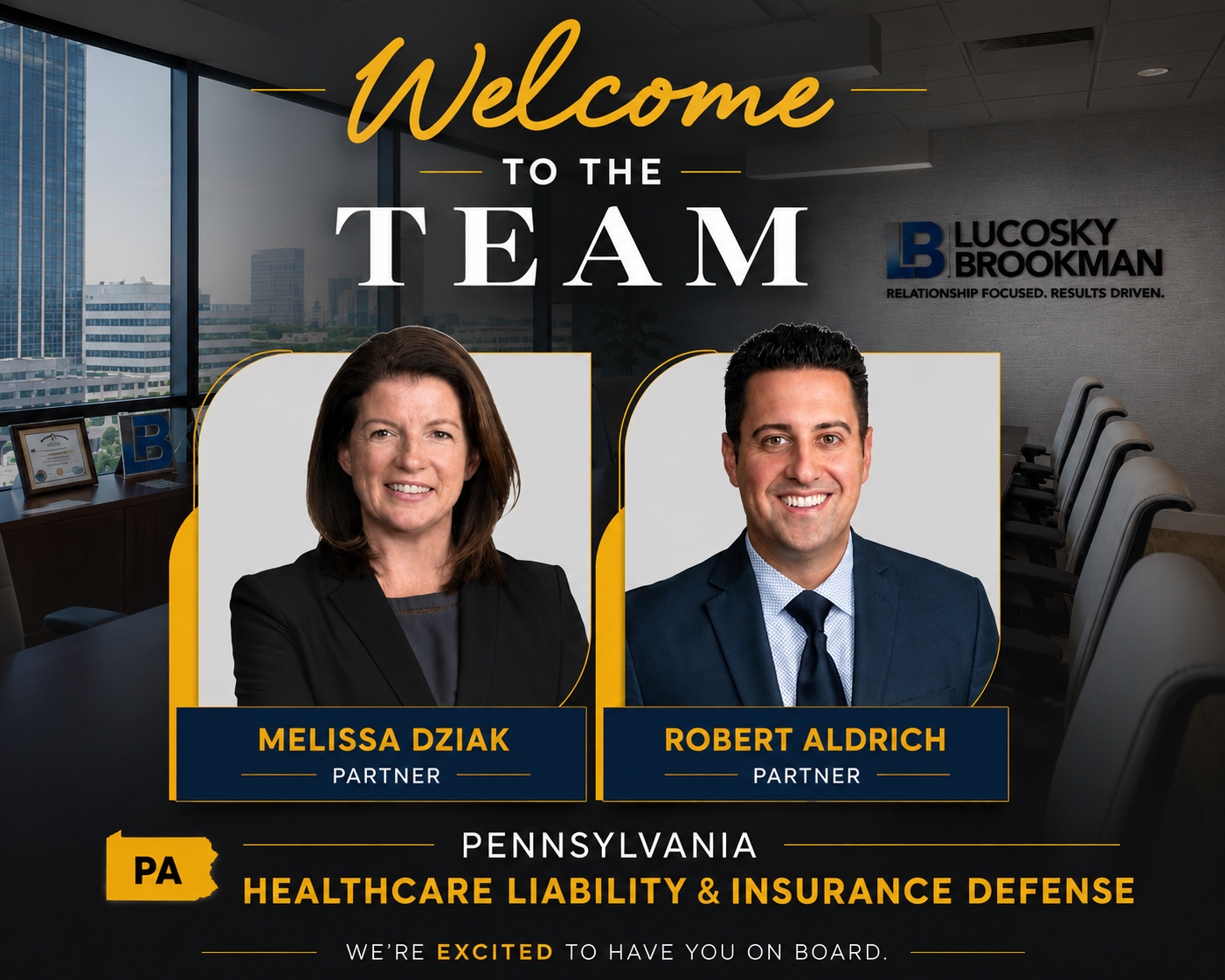
Rob Aldrichis a member of the Insurance Coverage & Defense Practice and Healthcare Litigation & Medical Malpractice Defense team. He concentrates his practice on defending healthcare professionals, hospitals, healthcare systems, and long-term care facilities in medical malpractice litigation throughout Pennsylvania and New York. A large portion of his practice is also devoted to representing trucking and transportation companies in catastrophic injury and complex automobile liability litigation.
Known for his practical, hands-on approach, Rob is deeply invested in every case he handles. He works closely with clients to develop results-oriented defense strategies tailored to the unique facts and risks of each matter. A persuasive writer, skilled litigator, and strategic thinker, Rob is recognized for efficiently navigating complex litigation while keeping clients’ business and professional objectives at the forefront. His experience working within the judicial system provides valuable insight into how courts evaluate legal arguments, allowing him to anticipate issues and advocate effectively throughout every stage of litigation.
Rob is an active leader within the defense bar. He currently serves as Executive Vice President of the Pennsylvania Defense Institute. He is also a frequent author and speaker on issues affecting healthcare providers and the defense community, including artificial intelligence, healthcare risk management, medical malpractice litigation, electronic medical records, and audit trails.
Before entering private practice, Rob served judicial clerkships with the Supreme Court of Pennsylvania and the Monroe County Court of Common Pleas. Those experiences provided him with a strong foundation in litigation and trial practices that continue to enhance his defense strategies today.
Classes/Seminars Taught
- Navigating the Digital Shift: Balancing The Benefits and Legal Risks of Patient Portals, Pennsylvania Association for Health Care Risk Management (PAHCRM) webinar, February 11, 2026
- Navigating the Digital Shift: Balancing The Benefits and Legal Risks of Patient Portals, ASHRM Annual Conference, Charlotte, North Carolina, September 28, 2025
- It Is Not All About the Virus: Defending “Other COVID-19” Pandemic Claims, ASHRM Annual Conference, Boston, Massachusetts, September 13, 2022
- Artificial Intelligence and Dentistry: Protecting Yourself From Liability, client webinar, June 16, 2022
- 21st Century Cures Act: The Do’s and Don’ts and Ways to Ensure Compliance, WVSHRM 2022 Spring Conference, May 20, 2022
- 21st Century Cures Act: The Do’s and Don’ts and Ways to Ensure Compliance, client webinar, January 27, 2022
- Legal Marketing on LinkedIn: Learn How Law Firms are Leveraging LinkedIn’s Unique Data and Environment to Engage Clients and Prospects to Grow Their Business, Pennsylvania Defense Institute Annual Conference, Bedford Springs, Pennsylvania, July 15, 2021
- 21st Century Cures Act, webinar, Pennsylvania Association for Health Care Risk Management Spring Conference, April 15, 2021
- Jury Trials in the Era of COVID-19, webinar, September 24, 2020
- Preparing A Claim for Trial: How Recent Issues, Decisions and Trends Are Impacting Litigation Outcomes, client webinar, June 4, 2020
- A Recurring Nightmare: Department of Health Citations and Their Impact on Corporate Liability and Punitive Damages, Marshall Dennehey Health Care and Health Law Seminar, November 7, 2019
- 2018 Update: The EMR, Audit Trails and Mobile Devices: How to Narrow Your Professional Liability Exposure, 14th Annual Medical Liability Insurance ExecuSummit, Uncasville, Connecticut, October 17, 2018
- The Impact of Department of Health Violations on Corporate Liability, PAHCRM Spring Conference, Wilkes Barre, Pennsylvania, April 13, 2018
Published Works
- “Navigating The Digital Shift: Defending Medical Malpractice Claims in the Era of Patient Portals,” The Legal Intelligencer’s Medical Malpractice Supplement, April 22, 2025
- “Attention All Shoppers! There Is a Blue Light Special on Forum Selection in Pennsylvania Medical Malpractice Cases,” Defense Digest, Vol. 29, No. 3, September 2023
- “Pennsylvania Superior Court Reinforces Evidentiary Issues Commonly Raised in Medical Malpractice Trials,” Defense Digest, Vol. 26, No. 1, March 2020
- “A Civil Jury Trial During the Pandemic: Observations From Those Who Know,” The Legal Intelligencer, August 7, 2020
- “The Whole Is NOT Greater Than Its Parts – Third Circuit Applies Component-Level Analysis To Preemption of Hybrid Medical Devices,” CounterPoint, April 2018
- “Negligent Advice of a Class III Medical Device Sales Rep,” The Legal Intelligencer, Medical Malpractice Supplement, April 11, 2017
- Obtained a defense verdict on behalf of an anesthesiologist after a medical malpractice jury trial in Lehigh County. The plaintiff, who underwent an elective right-shoulder surgery, alleged that the anesthesiologist and the CRNA who performed his laryngoscopy intubated him too soon, and under suboptimal paralytic conditions, leading to permanent throat damage. After a five-day trial, the jury returned a defense verdict within 15 minutes.
- Received a defense verdict in a dental malpractice case involving allegations of the use of excessive force and the failure to obtain the patient’s informed consent after a patient’s jaw was fractured during a molar extraction. It was admitted that jaw fracture was a known risk of the extraction, but that the dentist did not warn the patient of this risk. It was also conceded that the dentist caused the fracture. Lastly, the patient’s damages were not contested, which included the pain and suffering associated with the fracture and permanent numbness to the lower jaw. On cross-examination of the patient’s seasoned expert, he was confronted with prior inconsistent testimony regarding his experience in extracting molars and his opinion that all risks of a procedure need to be shared with the patient. Further, the expert agreed with the defense’s argument that the risk of jaw fracture of an erupted right lower molar was less than .0009% and the patient had a better chance of dying from complications associated with the extraction than suffering a fracture. The jury was persuaded by the defense’s arguments early in the case due to the thorough cross-examination of the patient’s expert.
- Obtained a defense verdict in binding arbitration on behalf of a nursing home client. The plaintiff alleged that the nursing staff provided inadequate pressure reducing devices and negligently cared for his lower extremity, allegedly resulting in a below-the-knee amputation and permanent and total disability. Rob defended the case by establishing not only that the nursing staff treated the resident in accordance with the standard of care, but also that the resident’s below-the-knee amputation was caused by vascular conditions and comorbidities and not by any alleged actions and/or inactions of the nursing home staff. After a lengthy arbitration, the arbitrator ultimately found in favor of the defense.
- Obtained a defense verdict in a lengthy binding arbitration on behalf of a hospitalist physician practice group. The plaintiff alleged that he sustained a brain injury from a code blue event he had in the hospital while awaiting an emergency cholecystostomy. The plaintiff alleged that the event was caused by overprescribing pain medications and failure to recognize a history of obstructive sleep apnea. The defense presented the arbitrator with alternative causation theories from significantly qualified specialists.
- Received a unanimous defense jury verdict in a lengthy fire-loss subrogation trial. This case was one of the first Pennsylvania civil jury trials held during the COVID-19 pandemic. Taking into account safety and social distancing protocols, jury selection took place in a local school auditorium, two witnesses presented testimony via Zoom, and everyone present in the courtroom was subject to temperature screenings and required to wear a face covering. Given the current national health situation, this trial could serve as an example of how the court system and counsel can adapt to the changing health and legal landscape.
- Obtained a defense verdict in a nursing negligence case. The plaintiff alleged to have suffered a fall in a hospital bathroom three days post-operatively that re-injured his surgically repaired knees. The nurses denied the patient fell to the ground and testified, consistent with their charting, that the patient lost balance in the bathroom and sat on a commode. There was a significant economic damage claim in that the plaintiff was a young restaurant owner who suffered two distinct orthopedic injuries that required multiple surgeries and additional future care.
- Health Care Law
- Medical Malpractice Law – Defendants